

Looking for the right Bag-in-box format for your product? Contact our packaging specialists directly at baginbox@technologia.com.ua to discuss custom volume requirements and technical specifications.
Bag-in-box packaging is worth a closer look when a liquid product requires reliable protection, efficient transport and convenient dispensing without the addition of unnecessary materials.
The concept is straightforward: a flexible inserting-bag holds the product while an outer container provides structure and protection. But the technology behind the format is considerably more sophisticated than the concept suggests.
Modern Bag-in-box packaging can be designed for different products, capacities, barrier requirements, filling temperatures and dispensing systems. It is used for wine, juice, dairy products, sauces, concentrates, liquid eggs, edible oils, water and industrial liquids.
Since 2012, TECHNOLOGIA JSC has manufactured Bag-in-box packaging and dispensing components for capacities ranging from 2 to 220 litres. The company integrates film extrusion, laboratory testing and R&D support into its packaging operations.
This guide explains how the system works, how the bags are manufactured, which materials and dispensing options are available, when aseptic packaging makes sense, and what to consider when selecting a packaging partner.
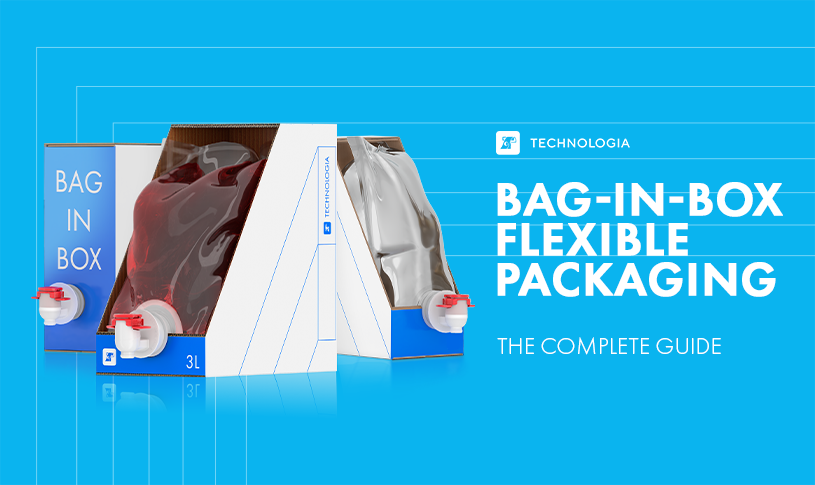
At its simplest, a Bag-in-box system consists of three main elements: a flexible inserting-bag , a dispensing or filling fitment, and an outer container.
The inserting-bag is manufactured from flexible multilayer film selected according to the product and its protection requirements. The bag is then placed inside a rigid outer package, most commonly a cardboard box, although other formats can also be used.
The outer container provides mechanical support and a practical surface for handling, stacking and product communication. The flexible bag does the more critical job of containing and protecting the liquid product. The bag is the barrier: it touches the product, blocks oxygen and light, and holds its shape as it’s filled and squeezed empty.
TECHNOLOGIA JSC is one of the leading suppliers of bags for bag-in-box packaging, and our production runs to BRCGS Global Standard for Food Safety.
A typical Bag-in-box container combines several components that need to work as one system:
Empty bags arrive flat and take up very little storage volume. During filling, it is connected to the fitment on a Bag-in-box filling machine or compatible filling line. Once filled, the bag is sealed and placed inside the outer container.
During the filling (dispensing) process, the bag gradually compresses, minimizing the intake of air. This is a key reason oxidation-sensitive products like wine or dairy can outperform bottled equivalents.
The journey of a Bag-in-box system reflects unmatched efficiency throughout the modern supply chain:
To learn more about how flexible solutions are reshaping modern logistics, read our article on how flexible packaging meets global trends.
Transitioning from traditional rigid containers to flexible Bag-in-box packaging provides significant economic, environmental, and operational advantages.
Manufacturing industrial-grade flexible packaging requires strict environmental control, high-precision extrusion machinery, and certified quality controls.
TECHNOLOGIA JSC operates laboratories and an R&D process that can include testing packaging configurations, producing experimental batches and supporting trials on customer filling equipment.
The choice of Bag-in-box material should begin with the product and process, not with the film itself.
Wine, juice, milk, sauces and concentrates can have very different requirements for oxygen protection, light protection, temperature resistance and mechanical strength.
A crucial component of any successful Bag-in-box system is its closure and dispensing interface. TECHNOLOGIA JSC offers a full line of custom closures, taps, and caps engineered for clean, reliable dispensing.
| DISPENSING and FITMENT TYPES | |
| Fitment Type | Application and Dispensing Feature |
| T-Tap / T-Tap PTO / T-Tap REVOLVER Milk Cap with Tube / Plug with Tube (straight or horizontal formats) Snap Cap / Screw Cap Elpo Plug | Ergonomic one-hand wine and beverage dispensing Direct hygienic connection to dairy equipment High-flow pouring for sauces, oils, industrial bulk Specialized commercial aseptic dispensing |
To help eco-responsible brands meet regulatory targets and minimize plastic waste without compromising flow control, we offer advanced dispensing innovations such as our T-TAP PTO and T-TAP REVOLVER next-generation taps.
These taps are fully compliant with EU Directive 2019/904 on single-use plastics. They are designed to reduce environmental impact while maintaining structural integrity and seal performance.
Choosing the right container capacity depends on end-use markets, consumer handling requirements, and distribution networks. A key advantage of Bag-in-box is the range of available capacities.
TECHNOLOGIA JSC manufactures Bag-in-box formats including:
Understanding the distinction between aseptic and non-aseptic processing helps liquid food producers select the ideal packaging setup.
| ASEPTIC VS. NON-ASEPTIC COMPARISON | ||
| Parameter | Aseptic System | Non-Aseptic System |
| Product Sterilization | Flash heated and cooled | Standard pasteurization |
| Filling Environment | Sterile steam/nitrogen | Clean environment |
| Cold-Chain Needs | Ambient storage | Often requires chillers |
| Ideal Applications | Milk, Egg, Concentrates | Fresh juice, Short dairy |
Non-aseptic systems can be appropriate where the product and filling process do not require sterile packaging conditions.
This approach can provide a relatively straightforward packaging and filling process while retaining the logistical and material advantages of Bag-in-box.
Aseptic Bag-in-box is designed for applications where the packaging and filling process must meet much tighter microbiological requirements.
An aseptic Bag-in-box filler is therefore a specialised part of the overall process.
Aseptic filling removes cold-storage dependency and lowers logistics costs, at the price of more specialized equipment, including a validated bag in box aseptic filler. The choice generally comes down to product stability, distribution footprint, and existing cold-chain infrastructure.
Comparing Bag-in-box with rigid plastic packaging only by retail appearance misses much of the difference.
A rigid bottle must retain its shape throughout its entire lifecycle. A flexible bag only needs enough material and structural strength to contain and protect the product while the outer package provides additional support. That distinction can significantly affect material use.
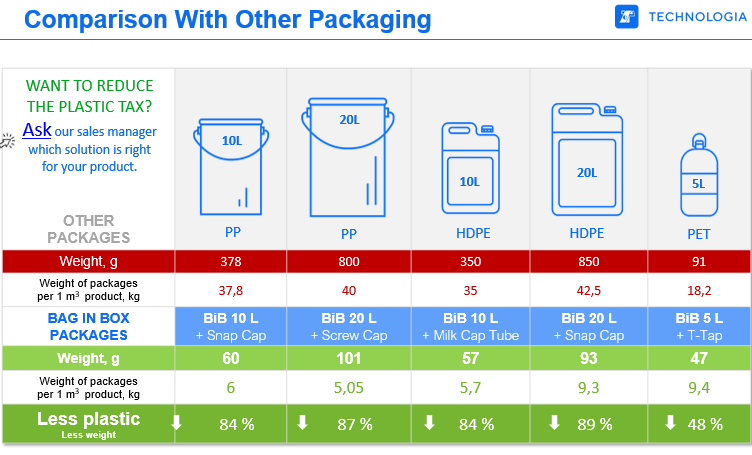
TECHNOLOGIA JSC’s comparative data show examples where Bag-in-box uses 48% to 89% less plastic than selected rigid packaging alternatives, depending on format. A 20L configuration, for example, is reported at up to 89% less plastic than the compared rigid package.
The comparison continues into logistics.
Empty flexible bags are compact. Filled rectangular packages can be stacked efficiently. The package does not need the same level of rigid material to maintain its shape.
Bag-in-box is used across food, beverage and industrial applications because the system can be adapted rather than forcing every product into the same package specification.
For wine producers, bag in the box wine and wine in bag in box formats can combine controlled dispensing with lower package weight.
For dairy, packaging needs to protect milk from oxygen, light, contamination and external odours.
The same logic applies to bag in box juice, sauces and concentrates.
Across its life cycle, Bag-in-box format leaves a meaningfully lighter footprint: less plastic, energy, and packaging weight, and fewer trucks per liter delivered. A single truck carries roughly 17,784 liters using standard 19L bottles versus around 31,200 liters using 10L Bag-in-box – nearly double the product per trip. Producing a 1L PET bottle carries a carbon footprint of roughly 259 kg, versus about 31 kg for an equivalent 5L PET Bag-in-box.
There’s also no need to wash or sanitize returnable packaging before reuse, since the format isn’t designed for reuse – removing a whole category of water and chemical use and supporting genuine end-of-life recycling. Modern monomaterial film structures, like our transparent inserting-bag, are now independently certified for high recyclability rather than simply claimed to be recyclable.
The EU Packaging and Packaging Waste Regulation (PPWR) introduces requirements to reduce packaging waste and improve packaging circularity. Bag-in-box can support these objectives through material efficiency, packaging minimisation and recyclability.
Material efficiency and packaging minimisation. From 2030, packaging must be designed with the minimum weight and volume necessary to perform its intended function. The lightweight flexible structure of Bag-in-box allows the required product protection and functionality with significantly less packaging material than many rigid alternatives.
Recyclability. Under the PPWR, packaging placed on the EU market will have to meet defined recyclability requirements from 2030, with these requirements becoming progressively stricter over time. Our inserting-bags with T-TAP dispensers already demonstrate a high level of recyclability today. They have received a “Made for Recycling” certificate from Interzero Recycling Alliance GmbH, achieving a “Good” rating with 16 out of 20 points for compatibility with existing recycling infrastructure. 96.4% of the packaging mass was assessed as recyclable.
Reflecting its exceptional engineering, this innovative solution was recognized in 2026 with the Ukrainian Packaging Star award for its outstanding combination of barrier protection and eco-friendly recyclability.
Waste prevention and resource efficiency. Using less packaging material for the same product volume can reduce the amount of packaging entering the waste stream and improve transport and storage efficiency. These characteristics make Bag-in-box relevant to the PPWR’s broader objectives for packaging waste prevention and more efficient use of resources.
When comparing Bag-in-box manufacturers or Bag-in-box suppliers, look beyond the price of the empty bag.
Start with the product.
What is its composition? How sensitive is it to oxygen or light? What shelf life is required? Is hot filling, cold filling or aseptic filling involved? How will the finished package be stored and transported? How will consumers or operators dispense it?
The answers determine the required film structure, capacity, closure and filling configuration.
Need expert guidance selecting the exact film structure and dispensing fitment for your processing line? Contact us today at baginbox@technologia.com.ua to request custom technical datasheets and competitive volume pricing.
It is a flexible packaging system consisting of a multi-layer protective inner bag fitted with an airtight dispenser, housed inside a protective outer box or rigid shell.
Common applications include wine, juice, milk and other dairy products, water, sauces, liquid eggs, fruit purees, concentrates, oils and selected industrial liquids.
A Bag-in-box liner is the flexible inserting-bags that directly contains the product. Its material structure is selected according to the liquid, filling process and shelf-life requirements.
Yes. TECHNOLOGIA JSC produces both aseptic and non-aseptic configurations, including 220L industrial formats.
Standard polyethylene and multi-layer film inserting-bags support filling temperatures ranging from 4°C up to 90°C (hot filling), with industrial bulk inserting-bags tolerating temporary steam sterilization protocols up to 110°C.
Because the internal inserting-bags collapses without admitting air during dispensing, oxidation-sensitive products like wine, juice, or liquid eggs can stay fresh for weeks or months after opening.
There is no blanket answer for every Bag-in-box package.
PPWR applies to packaging placed on the EU market and introduces requirements concerning recyclability, recycled content and design for recycling. The compliance status must therefore be evaluated for the specific Bag-in-box structure and its components. TECHNOLOGIA JSC is developing recyclable Bag-in-box structures with these future requirements in mind.
Yes. Outer corrugated boxes are widely recycled through standard paper recycling streams. For the flexible inserting-bags, monomaterial structures (such as our certified monomaterial PE inserting-bags) achieve up to 96,4% recyclability.
The total cost can be affected by material use, filling, transport, warehouse space and handling. In some applications, the lower package weight and more efficient logistics can create savings beyond the purchase price of the empty package.
The reasons Bag-in-box packaging keeps displacing rigid containers aren’t complicated: less material, less weight, better protection for sensitive products, and a genuinely lower environmental footprint.
At the same time, the packaging industry is entering a new regulatory phase. The PPWR is now applicable in the EU, and recyclability and design for recycling are becoming increasingly important criteria for packaging placed on the European market.
For that reason, choosing a Bag-in-box manufacturer today should involve more than capacity and price. Material structure, filling compatibility, product protection, technical support and documented recyclability increasingly matter just as much.
TECHNOLOGIA JSC develops Bag-in-box packaging with this complete-system approach – from film and inserting-bag to fitment, dispensing and application-specific engineering.
If you are looking for Bag-in-box packaging solutions, need a technical assessment, or want to discuss a custom Bag-in-box packaging format, contact our packaging team: baginbox@technologia.com.ua